
 (361) 232-5577
Compare Invisalign and braces for teens, including treatment options, daily responsibilities, oral hygiene, costs, and treatment considerations.
Invisalign vs. Braces for Teens: Which Is Right for Your Child?
10 Minutes Read
 By: Dr. Timothy Kuhlman
Table of content
For parents comparing Invisalign vs. braces for teens, there is no single option that is right for every teenager. Both can move teeth and correct many orthodontic concerns, but they work differently and place different responsibilities on the patient.
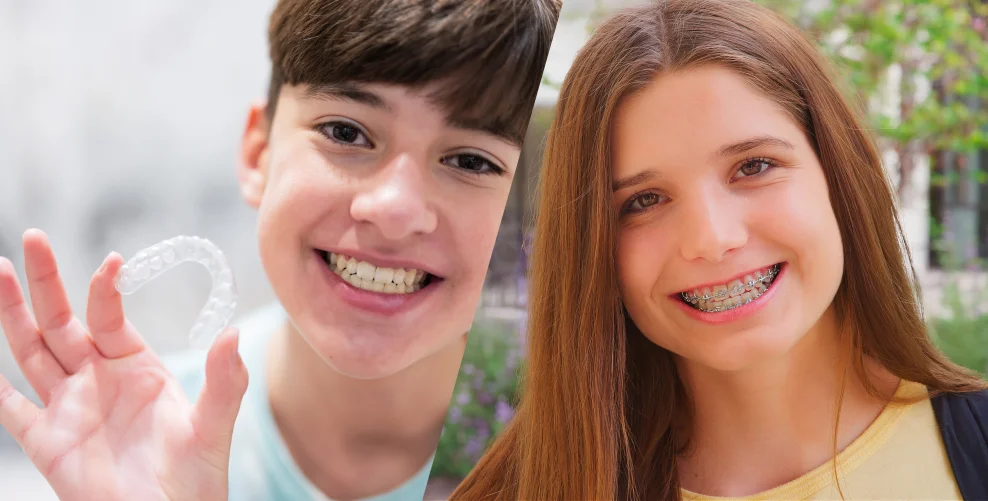
Braces are fixed to the teeth and work continuously. Invisalign uses a series of removable clear aligners that need to be worn consistently for the prescribed number of hours each day.
The right choice depends on your teen’s bite, crowding or spacing, the tooth movements required, oral hygiene, lifestyle, and especially with removable aligners their ability to follow the treatment plan.
The American Association of Orthodontists notes that both braces and clear aligners can be effective, but some orthodontic problems are treated more predictably with braces.
Braces and Invisalign Work in Different Ways
Both treatments apply controlled forces to gradually change tooth position, but the appliances are very different.
Traditional Braces
Braces use brackets attached to the teeth and an orthodontic wire that guides tooth movement.
Because braces remain attached throughout treatment, your teen does not need to remember to put them back in after meals or school activities.
Braces can be used for a wide range of orthodontic concerns, including:
Crowded teeth
Gaps between teeth
Rotated teeth
Overbites
Underbites
Crossbites
Open bites
More involved tooth movements
Kennedy Dental Care describes braces as an option for children, teens, and adults, including cases that may be more complex than those suitable for aligners.
Invisalign Clear Aligners
Invisalign treatment uses a sequence of custom clear trays that fit over the teeth.
Each set applies controlled pressure to help move teeth toward their planned positions. The aligners are removable for meals, brushing, and flossing.
For treatment to progress as planned, aligners generally need to be worn around 20–22 hours per day, or according to the orthodontist's instructions.
At Kennedy Dental Care, Invisalign and clear aligner treatment are available for teens and adults.
Invisalign vs. Braces for Teens at a Glance
| Consideration | Braces | Invisalign |
|---|---|---|
| Appliance | Fixed brackets and wires | Removable clear aligners |
| Visibility | More noticeable | Less noticeable |
| Daily wear responsibility | Always attached | Requires consistent daily wear |
| Eating | Some hard, sticky, or chewy foods may need to be avoided | Aligners removed for meals |
| Brushing and flossing | Requires cleaning around brackets and wires | Aligners are removed for normal brushing and flossing |
| Lost appliance risk | Lower because braces are fixed | Trays can be misplaced or damaged |
| Sports | Mouthguard considerations are important | Aligners can be removed as instructed when a sports mouthguard is needed |
| Appearance | Metal brackets are visible | Clear trays are relatively discreet |
| Patient responsibility | Important | Particularly important because wear time affects treatment |
The comparison is not meant to identify a universal winner. The orthodontic diagnosis matters more than appearance alone.
Orthodontic Problems Both Options May Address
Teens may be referred for orthodontic evaluation because of tooth alignment, bite development, or jaw relationships.
Concerns may include:
Crowding
Spacing
Crooked teeth
Overbite
Underbite
Crossbite
Open bite
Teeth that have erupted in unusual positions
Clear aligners can treat many types of crowding, spacing, and bite concerns, but they are not suitable for every case.
Braces may give the orthodontist more direct control over certain complex tooth movements.
AAPD guidance emphasizes that adolescent orthodontic treatment should be based on professional diagnosis, treatment options, patient motivation, readiness, and the individual orthodontic problem.
Treatment Complexity and Tooth Movement
One of the most important factors when comparing Invisalign or braces for your teen is the type of movement required.
A teenager with relatively straightforward crowding or spacing may have more than one appropriate treatment option.
A teenager with:
Significant rotations
More complex bite relationships
Difficult tooth positions
Teeth that require substantial movement
Other developmental or skeletal concerns
may benefit from a different orthodontic approach.
Braces can treat a broad range of malocclusions because brackets and wires remain attached and allow the orthodontist to control tooth movement throughout treatment. Clear aligners can also manage many orthodontic problems, sometimes with attachments or elastics, but some cases are more predictably managed with fixed appliances.
An orthodontic examination is therefore more useful than selecting treatment solely because your teen prefers one appliance.
Teen Responsibility and Treatment Compliance
This is one of the largest practical differences between braces and Invisalign.
Braces work continuously because your teen cannot take them off.
Clear aligners are removable, which can be convenient—but that convenience also requires responsibility.
Your teen generally needs to:
Wear aligners for the prescribed amount of time
Remove them for meals
Brush before putting them back in
Change trays according to instructions
Store aligners safely when removed
Bring them to orthodontic appointments
Avoid losing or damaging them
The AAO notes that aligners only move teeth while they are being worn and generally require approximately 22 hours of daily wear.
A teen who frequently forgets retainers, loses personal belongings, or is unlikely to follow an aligner schedule may find fixed braces easier to manage.
That does not mean braces require no responsibility. Good brushing, food precautions, elastics when prescribed, and keeping appointments remain important.
Appearance and Confidence During Treatment
Appearance can be an important consideration during adolescence.
Some teenagers prefer Invisalign because the clear trays are less noticeable than traditional metal brackets.
Other teens are comfortable with braces and may even enjoy choosing different elastic colours.
Neither choice should be presented as automatically better for confidence. Teenagers vary considerably in how they feel about orthodontic appliances.
A useful conversation includes your child's preferences while also making sure the selected treatment can appropriately address the orthodontic problem.
AAPD guidance recognizes that adolescence involves social and emotional factors that can influence oral healthcare decisions and treatment readiness.
Eating With Invisalign and Braces
Food habits differ significantly between the two options.
Eating With Braces
Because brackets and wires stay attached to the teeth, your orthodontic team may recommend avoiding foods that can damage the appliances.
Examples may include:
Hard candy
Ice
Sticky sweets
Very chewy foods
Hard foods bitten directly with the front teeth
Foods can often still be enjoyed by changing how they are prepared, such as cutting firmer foods into smaller pieces.
Eating With Invisalign
Clear aligners are removed before meals and before drinking beverages other than water, according to the orthodontist's instructions.
This means there are generally fewer appliance-related food restrictions.
However, the aligners need to be put back in after eating and cleaning the teeth. Long periods with the trays out can reduce the amount of time they are able to apply orthodontic forces.
Oral Hygiene During Teen Orthodontic Treatment
Oral hygiene matters with either treatment.
The AAPD emphasizes maintaining good oral hygiene and routine dental care during orthodontic treatment to reduce problems such as enamel demineralization.
Cleaning With Braces
Brackets and wires create additional areas where plaque and food can collect.
Teens need to clean carefully around:
Brackets
Wires
Gumlines
Areas between teeth
The orthodontic team may recommend floss threaders, interdental brushes, or other cleaning aids.
Cleaning With Invisalign
Aligners can be removed, so teens can generally brush and floss their teeth without brackets or wires in the way.
The trays themselves also need regular cleaning.
Kennedy Dental Care advises aligner patients to clean the trays daily with a soft toothbrush and lukewarm water and to avoid hot water that may distort the aligners.
Removable aligners can simplify access for brushing, but they do not eliminate the need for consistent oral hygiene.
Comfort During Orthodontic Treatment
Both braces and Invisalign move teeth by applying pressure, so some temporary tenderness or pressure can occur during orthodontic treatment.
With braces, teens may notice tenderness after placement or adjustments. Brackets and wires may also temporarily irritate the lips or cheeks.
Clear aligners do not use metal brackets or wires, but a new tray may feel snug or create temporary pressure as teeth begin responding to it.
Kennedy Dental Care notes that new aligners can feel snug for a short period.
For advertising and patient education purposes, it is more accurate to describe either treatment as having different comfort considerations rather than claiming one is universally "painless."
Sports and Teen Orthodontics
Teen athletes can receive orthodontic treatment, but protection of the teeth and appliances is important.
With braces, an orthodontic compatible sports mouthguard may be recommended for activities with a risk of facial impact.
Clear aligners are removable, but they are not substitutes for protective sports mouthguards.
Your orthodontist can explain how your teen should manage braces or aligners during practices and games based on the sport and appliance.
Treatment Time for Braces and Invisalign
Parents understandably want to know which option is faster.
There is no reliable universal answer.
Orthodontic treatment length depends on factors such as:
Severity of crowding
Bite relationship
Tooth movements required
Growth and development
Treatment method
Wearing aligners or elastics as instructed
Appointment attendance
Appliance breakage or lost trays
AAO guidance notes that treatment duration varies according to the orthodontic problem and that cooperation with aligner or elastic wear can affect progress.
Therefore, claims such as “Invisalign is always faster” or “braces always take longer” would be misleading.
Your orthodontist can provide an estimated timeline after evaluating your teen's teeth and bite.
Orthodontic Appointments and Lifestyle
Both braces and Invisalign require ongoing professional monitoring. With braces, appointments allow the orthodontist to check tooth movement, wires, brackets, bite relationships, and other aspects of treatment.
With Invisalign, visits may be used to monitor whether teeth are tracking with the planned movements, provide additional aligners, and adjust the treatment plan when needed.
A lost aligner, broken bracket, loose wire, or missed appointment can potentially affect treatment progress.
Parents should consider which option fits realistically with their teen's school routine, extracurricular activities, travel, and ability to manage removable appliances.
Cost of Invisalign and Braces for Teens
The cost of orthodontic treatment varies by patient.
Factors may include:
Complexity of the orthodontic problem
Type of appliance
Expected treatment length
Additional appliances or procedures
Insurance orthodontic benefits
Individual treatment plan
Kennedy Dental Care advises that braces costs depend on the case and treatment duration and provides an itemized estimate after consultation. The practice also lists insurance benefits and financing options that may be available depending on eligibility and plan terms.
Parents should request a treatment estimate instead of assuming that Invisalign or braces will always be less expensive.
Retainers After Invisalign or Braces
Finishing braces or the final Invisalign tray does not mean orthodontic care is completely finished.
After active tooth movement, retainers are commonly used to help maintain the new tooth positions.
The AAO notes that patients generally need retention after orthodontic treatment regardless of whether they used braces or clear aligners.
Your teen's orthodontist will recommend the type of retainer and wearing schedule based on the completed treatment.
Consistent retainer use is important because teeth can shift after orthodontic appliances are removed.
Schedule an Orthodontic Consultation
Not sure whether Invisalign or braces is right for your teen? Schedule a consultation with Kennedy Dental Care to discuss your child’s orthodontic needs and available treatment options.
Matching the Treatment to the Teen
Instead of asking whether Invisalign or braces are universally better, consider which treatment is appropriate for both the orthodontic problem and the teenager.
Invisalign may be considered when:
The orthodontic problem is suitable for aligners
Your teen prefers a less noticeable appliance
They can reliably wear trays as prescribed
They are likely to keep track of removable aligners
Being able to remove the appliance for meals is important
They can maintain consistent oral hygiene and tray care
Braces may be considered when:
The case requires tooth movements better suited to fixed appliances
Your teen would struggle with required aligner wear
Losing removable trays is a concern
The orthodontist needs continuous appliance control
Your teen is comfortable wearing brackets and wires
These are general considerations, not treatment rules. The final recommendation should come from an orthodontic diagnosis.
Teen Orthodontics in Corpus Christi
Kennedy Dental Care provides teen orthodontics in Corpus Christi, including braces, Invisalign, and clear aligners.
Orthodontic treatment is planned and supervised by the practice's orthodontist, Dr. Timothy Kuhlman. Kennedy Dental Care's current location information states that orthodontic services, including braces, Invisalign, and clear aligners, are offered at the Saratoga and Calallen offices.
The practice also provides pediatric dentistry, allowing routine dental care and orthodontic treatment to be coordinated within Kennedy Dental Care.
An orthodontic consultation can help determine whether braces, Invisalign, or another approach may be appropriate based on your teen's teeth, bite, growth, and ability to manage treatment.
Start With an Orthodontic Evaluation
Both braces and Invisalign can be useful options for teenagers, but treatment should match your child's orthodontic needs rather than being selected based only on appearance or convenience.
Kennedy Dental Care can evaluate your teen's teeth and bite and explain the benefits, limitations, responsibilities, and expected treatment plan for the options that may be appropriate.
About the Author
Dr. Timothy Kuhlman specializes in orthodontics and has extensive experience in both traditional braces and clear aligners. He graduated from Ohio State University College of Dentistry and completed his orthodontic residency through the Tri-Service Orthodontic Residency Program in San Antonio. He also served 11 years in the U.S. Army, including two tours in Germany.
FAQ
Frequently Asked Questions About Invisalign vs. Braces for Teens
Neither option is universally better. The appropriate treatment depends on your teen's orthodontic problem, tooth movements, bite, lifestyle, and ability to wear removable aligners consistently.
Yes. Invisalign and other clear aligners can be appropriate for many teenagers when their orthodontic condition is suitable and they can follow the required wearing schedule.
Clear aligners can treat many types of crowding, spacing, and bite problems, but some complex orthodontic cases may be managed more predictably with braces.
Clear aligners are generally worn about 20–22 hours per day or according to the orthodontist's instructions. They are normally removed for eating, drinking anything other than water, brushing, and flossing.
Not necessarily. Treatment duration depends on the orthodontic problem, tooth movement required, treatment plan, patient cooperation, and other individual factors.
Aligners can be removed for normal brushing and flossing, while braces require cleaning carefully around brackets and wires. However, Invisalign trays also need to be cleaned and the teeth should be kept clean before the trays are replaced.
Yes. Teens can participate in sports during orthodontic treatment. A suitable sports mouthguard may be recommended, particularly for contact or collision sports.
Aligners are generally removed for eating, so they do not have the same appliance-related food restrictions as braces. Teens still need to follow the orthodontist's instructions and return the aligners promptly after meals.
Retention is generally needed after both braces and clear aligner treatment to help maintain the corrected tooth positions.
Kennedy Dental Care's current location information lists braces, Invisalign, and clear aligners at its Saratoga and Calallen offices.